History Of Three Old Age Homes In Pietermaritzburg
By P.G Alcock
A brief history is provided of the Emma Barter Home in Retief Street, the Victoria Memorial Home (also in Retief Street) and the Allison Homes Trust complex in the vicinity of these two premises, which are all situated in the older parts of Pietermaritzburg. Emphasis has been placed on the early years of the three old age homes. All the homes are registered non-profit organisations.
Both the Emma Barter Home and the Victoria Memorial Home had humble beginnings. Emma Henrietta Arabella Barter née Butler (1827–1888) was born in Ireland and came to Natal in May 1855 as one of Bishop Colenso’s missionary party. The plan was that she would be a “lady visitor” at the Anglican Cathedral in Pietermaritzburg. She married Charles Barter in February 1856 and lived for 20 years at Karkloof, near Howick. After a brief interlude in Verulam in the late 1870s, the Barters moved to Pietermaritzburg in 1880 when Charles was appointed resident magistrate. Emma Barter had a strong social conscience and became active in the Pietermaritzburg Benevolent Society. One of her special interests was destitute children. Her name lives on, however, because of her involvement in the building of almshouses in Pietermaritzburg. She called a meeting to discuss the subject with a committee being elected to assist her to achieve this objective. Its first meeting was held on 13 April 1882 and was chaired by Sir Theophilus Shepstone. Both Charles Barter and his brother George served on the committee in an important capacity for a time.
The next step in the establishment of almshouses was the donation by the Corporation of Pietermaritzburg to the mayor and councillors of the city of a rectangular block of land bordering the current Burger, Retief, Prince Alfred and Collier streets (Deed of Transfer No. 682 of 1883). The land was to be held in trust as a site for the purpose of erecting almshouses. The first building to be constructed soon after the grant of land was registered was the Emma Barter Almshouses (currently the Emma Barter Home). The foundation stone was laid on 29 August 1883 by the Mayoress, Mrs Samuel Williams. A regimental band was in attendance on the day along with several leading citizens of Pietermaritzburg. The first resident (a woman) moved in during December 1883.
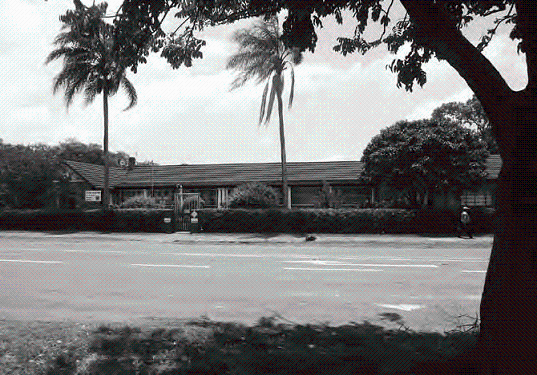
Image: The Emma Barter home
It was apparently not the intention that the almshouses should be reserved exclusively for women, although all the applicants in the early years were women. A man applied in 1896 but was rejected on the grounds that the almshouses could not then admit men. The original building consisted of 12 bedrooms, at least one outside storeroom, a kitchen and perhaps a lounge. The entrance to the home was in Burger Street. (It is now in Retief Street.) Further additions to the home were built in two main stages in later years. The Collins Wing consisting of seven bedrooms was completed in 1955, which was paid for by a former mayor of Pietermaritzburg, Harry Collins. A Chapel Wing followed in the late 1980s consisting of a chapel, a lounge and several bedrooms. An adjacent cottage in Burger Street was bought in the late 1990s to provide extra bedrooms for residents.
The home presently accommodates a maximum of 31 residents but does not have a frail care facility. A 24-hour nursing service is available.
It appears that almshouses for men were contemplated in the 1880s, with a number of years elapsing before this became a reality. The committee and trustees of the Emma Barter Almshouses and the mayor and city council subsequently gave permission for the building of further almshouses on the remainder of the land, although it was only in 1896 that the council agreed to the registration of a sub-division of the property. The actual construction of an almshouse for men was evidently proposed in 1901 by the women of the Maritzburg Ladies’ Memorial Fund who approached the trustees of the Emma Barter Almshouses in this regard. It was decided at the annual general meeting of the trustees in February 1902 that the subdivided land would be leased to the Maritzburg Ladies’ Memorial Fund. The new home would also serve as a memorial for the recently deceased Queen Victoria, and was to be known as the Queen Victoria Memorial Home.
The foundation stone of the second almshouse was laid on 23 August 1904 by the Chief Justice of the Supreme Court of Natal, Sir Henry Bale, who was then acting as the Administrator of Natal in the temporary absence from office of the Governor. The name of the builder, also recorded on the foundation stone, was F.W. Lawrance. The architects, likewise listed, were Stott and Kirkby. The home was officially opened on 29 March 1905 by the Governor of Natal, Sir Henry McCallum. The first committee meeting of the new home was held on 29 April 1905 and was attended by several prominent citizens of Pietermaritzburg.
A Deed of Trust was drawn up and registered in 1908, whereby trustees of the home were appointed to administer the trust and to make rules and regulations for the home. The word “Queen” was then dropped from the official name of the home for reasons unknown. The original objectives of the trust included providing a home for aged and infirm European males, and board and lodging for those in this category who were unable to support themselves financially. It seems that amongst the first residents of the home were veterans of the Anglo-Boer War of 1899–1902 and the Bambatha (Zulu) Rebellion in Natal which occurred in the period February–July 1906. Later residents included ex-soldiers who had fought in the two world wars. A feature of the home in the early days was a room furnished in loving memory by the sisters of the late Captain Bruce Steer DSO, who died in South Africa on 21 September 1904. Likewise noteworthy is a room bearing a plaque of the South African Legion (British Empire Service League) which is dated February 1924. An outside summer house was completed in 1955 which was funded by friends of the late Francis Charles Rodd, a former Master of the Supreme Court of Natal and a member of the committee of the home.
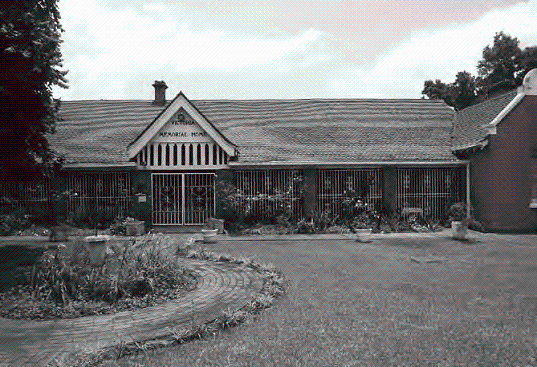
Image: The Victoria Memorial Home
A constant reminder of the connection with royalty is the large and imposing picture of Queen Victoria dated 1885, as well as other pictures of royalty which hang in the present-day lounge of the home. One wing of the home is called the Elizabeth Wing, with others bearing the names of Charles, Diana, Albert and Beatrice. The Royal Family paid a visit to the home during their tour of South Africa in 1947, accompanied by the Prime Minister of South Africa Jan Christiaan Smuts. A scroll commemorating this event was signed, strictly in order of rank, by the five visitors.
It appears that the home originally had 19 bedrooms, a kitchen, a storeroom and possibly a lounge, although this cannot be confirmed. A room to accommodate a single resident was added on to the existing building in March 1953, and was presented by the abovementioned Harry Collins. Generous donations made by Pietermaritzburg citizens during the 1970s enabled the home to build two major extensions, one housing a 14-bed frail care facility and the other additional bedrooms, toilets/bathrooms, an office and a flat for a member of staff. The home currently has space for a maximum of 50 residents with 24-hour nursing care available.
The Emma Barter Home and the Victoria Memorial Home were probably the first “official” old age homes in Pietermaritzburg for white women and men respectively. Both homes, interestingly, observed the Victorian prohibition of mixed residences for many years. The first men were only admitted to the Emma Barter Home in 2010, with the first women being admitted to the Victoria Memorial Home in 1989. An amalgamation of the two homes was initiated early in 2012 and at the time of writing is still far from complete. The combined facility is likely to be known in the future as the Emma Barter Victoria Home.
Built in a later era, but still retaining a link with royalty, were the King George V Memorial and the Queen Mary Place homes. The King George V Memorial Home for Aged Couples Trust was established in 1937. The objective was to raise funds to provide accommodation for elderly couples, and which would serve as a living memorial to King George V, who had died in January 1936. The facility was opened on 22 June 1937 by the Governor-General of South Africa, Sir Patrick Duncan, and consisted of a hall, a flat and six cottages. A flag pole, flying the Union Jack, was erected in front of the hall. Further cottages were built over the years. There are currently 89 cottages constituting the King George V Memorial Homes complex (the name applied to the entire facility). Each cottage has a bedroom, kitchen, bathroom, lounge/dining room and veranda. The home adjoins Burger, Retief and Prince Alfred streets.
Suitable accommodation for widows and other single women remained an issue, leading to the establishment of The Homes for Women Trust in 1940. The name of the trust was changed to the Queen Mary Place (Homes for Women) Trust in 1944. The first residents were admitted in 1945. The original cottages consisted of a lounge/dining room, an alcove functioning as a bedroom, kitchen, bathroom and veranda. A bedroom replaced the alcove in cottages built in more recent times, with all the other amenities as stated. The Queen Mary Place Homes presently consist of the Ruby Allison Hall and 183 cottages in sometimes discontinuous blocks of land situated in Burger and Prince Alfred streets and extending as far as Lytton Street. The “Cookery” was started in 2002 where frozen meals are prepared and sold by volunteer residents. Residents can buy certain commodities from a small shop situated in the grounds. Medical care is available at a clinic during the day on weekdays, but there is no frail care centre. The home now accepts single men, single women and couples.
The two homes were run as entirely separate entities, each with its own trustees and committee, until 1987 when the two trusts were amalgamated to become the Allison Homes Trust, which today has 318 cottages in total. The trust was involved in one further development in 1987 when 44 cottages were built on land immediately above and within the perimeter of the Sunnyside Park Home in Sweetwaters Road.
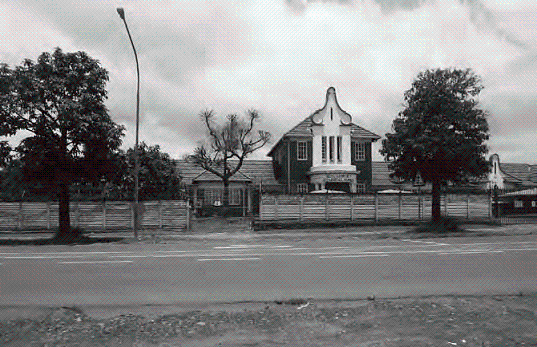
Image: The King George V Memorial Homes, forming part of the Allison Homes Trust
Two cottages were built later by private individuals but are now owned by the trust. The facility is known as the Albert Allison Haven.
The catalyst for the building of the King George V Memorial Homes and the Queen Mary Place Homes was a well-known Pietermaritzburg resident, Albert Thurlow Allison (1893–1979). His father J.W. Allison, a butcher and an astute businessman, had a farm in the Ladysmith district, and made a considerable amount of money selling cattle, horses and saddles to the British Army during the Anglo-Boer War. The father, probably realising that peace was at hand or was a reality, opened a saddlery business in Pietermaritzburg in 1902, before building more suitable premises at the upper end of Church Street in 1904. J.W. Allison died in 1936 with his son taking over the business (http://www.saddlery.co.za, accessed on 1/12/2012). The firm, though no longer owned by the family, is today known as Allison’s Saddlery and is currently situated in Victoria Road (in what was originally Joseph Baynes’ Pietermaritzburg warehouse).
Albert Allison, clearly financially secure, retired from the business world in 1930 at the age of 37 to devote his life purely to charitable endeavours. He was involved in raising money for children’s homes in the United Kingdom even before he retired, but later concentrated on good works in Pietermaritzburg, beginning with the King George V Memorial Homes. Ably assisted by his wife Ruby, he could see the need for additional accommodation for the elderly apart from the Emma Barter Home and the Victoria Memorial Home.
Allison was very active in seeking funds through private donations and bequests. Land was bought and the construction of cottages began, all using the same architectural plan. Allison used some of his own money for the building and maintenance of the cottages. One of the criteria for admission was that residents must not own a vehicle, obviously to avoid “free-loaders”. A number of slightly more wealthy elderly people, in the early days, paid a certain sum of money to have a cottage built for them at the King George V Memorial Homes, and were then entitled to live there rent-free (and rates-free) for the rest of their lives.
The Allisons lived for many years at 173 Alexandra Road, near the intersection of Alexandra and College roads. The property had extensive grounds enabling them to plant fruit trees and grow vegetables. Allison regularly donated his own fruit and vegetables to residents of the Queen Mary Place Homes and also bought produce from the market for this purpose. It is said that he used to stand in the centre of Pietermaritzburg giving away fruit to anyone who appeared to be in need.
Allison was mayor of Pietermaritzburg in 1935 and again in 1939–1943, and was also an elected member of the Natal Provincial Council during the years 1933–1965. He served on the board of several schools and was involved with the welfare of the coloured residents of Pietermaritzburg. He also helped a number of war veterans to obtain military pensions.
There is little doubt that Allison used his civic connections and his position as mayor to promote and facilitate his charity work, but which was always undertaken on the basis of his deep concern for the elderly. His motivation was simply “love and kindness”. His contribution was acknowledged by the Royal Family during their visit to Pietermaritzburg in 1947, when a Common Camellia or Japanese Camellia (Camellia japonica) was planted by the King at the entrance to the King George V Memorial Homes in Retief Street. In 1950 Allison received civic honours (the freedom of the city), had a road in the suburb of Scottsville named after him, and was a Justice of the Peace for more than 45 years. He was instrumental in establishing a bird sanctuary (which bore his name) on the opposite side of the N3 freeway from the present-day Liberty Midlands Mall. He requested that his name be removed when the bird sanctuary later fell into a state of neglect and disrepair. It is the proud declaration of the Allison Homes Trust that all funds for the building of accommodation for the elderly were obtained from private sources. The cottages stand today as a monument to the foresight and tenacity of Albert and Ruby Allison.
The information provided here can perhaps be termed “quiet history”. This category of history does not involve the thunderous and well-trodden path, for instance, of the Anglo-Zulu War or the Anglo-Boer War, but concerns ordinary yet compassionate men and women who made a difference to the lives of their fellows. They deserve to be remembered. It is in this spirit that the present brief account has been written.
The author sincerely thanks the management and staff of the three homes for information supplied for this note. Special thanks are due to Mesdames D. von Mayer and J. Polkey as well as Messrs G. Harrison, J. Lingard and P. Payne, all of Pietermaritzburg, who provided data in respect of the Allison Homes Trust. The biographical details of Emma Barter, her husband and her brother-in-law were derived from typewritten carbon copy notes found in a folder at the Emma Barter Home. It is strongly suspected that the information was sourced from material compiled at some stage by Dr Shelagh Spencer, the author of a series of books on early English settlers in Natal.
Notes and Queries
1) There is a row of eight almshouses, built to an English design, at 102 Longmarket (now Langalibalele) Street. The almshouses, known as the Charlotte Drew Bale House of Rest for Aged Women, were erected by William Ebrington Bale in memory of his wife, who died in 1898. On Bale’s death, the Bale Trust was created in terms of his will and a new block was added to the House of Rest, which bears his name.
2) Robert John Barnes was a wealthy Pietermaritzburg butcher who died in Liverpool in 1890. He left money for six almshouses in Pietermaritzburg and Durban. The almshouses in Pietermaritzburg were situated at 443 Longmarket Street.
3) A member of the Natalia editorial committee observes: “A.T. Allison was a true philanthropist, and also a charming eccentric in his way. He was one of the prominent figures in Pietermaritzburg when I was boy, an acquaintance of my parents, and I was often the recipient of his oranges, and of offerings from his stock of jokes and riddles. As he was mayor during the war years, he had a special line of juvenile Hitler riddles which appealed to us (e.g. ‘Why does Hitler wear two pairs of socks?’ ‘Because he smells defeat.’) He was always seen in a suit, as one would expect in those days, though his was usually rather rumpled, and always in a felt hat with turned-up brim that my mother referred to as ‘Mr Allison’s rain-catcher hat’.”
This article was copied from Natalia 43 (2013) Copyright © Natal Society Foundation 2013. We thank Natalia and P.G. Alcock for the use of this history of our homes.
The ‘Berlin Wall’ comes down
by Annzra Naidoo